
Editorial note: Much of this research took place over February 2026. Several documents that were removed from the public Epstein library have since been restored after public backlash and congressional hearings. The fact that they were removed in the first place (and the patterns around removal) is highly relevant. This note was written in early March, updates on availability are included.
Previously I noticed that results in the Epstein library were dropping for certain search terms. I wondered why. What was in the files being deleted? Removals were supposed to protect the sensitive information of those who were victimized in the case. My tracking seemed to show a different pattern. Many files containing powerful names were being removed from public view.
After over a week tracking search results, I decided to do a test. On February 12th, I selected a document I had saved and searched for it in the Epstein library. The very first one I searched for was no longer there.
Deleted file: EFTA01245100
The document that was removed in February was a tip to the FBI, submitted on July 7, 2020, which did not contain victim names.
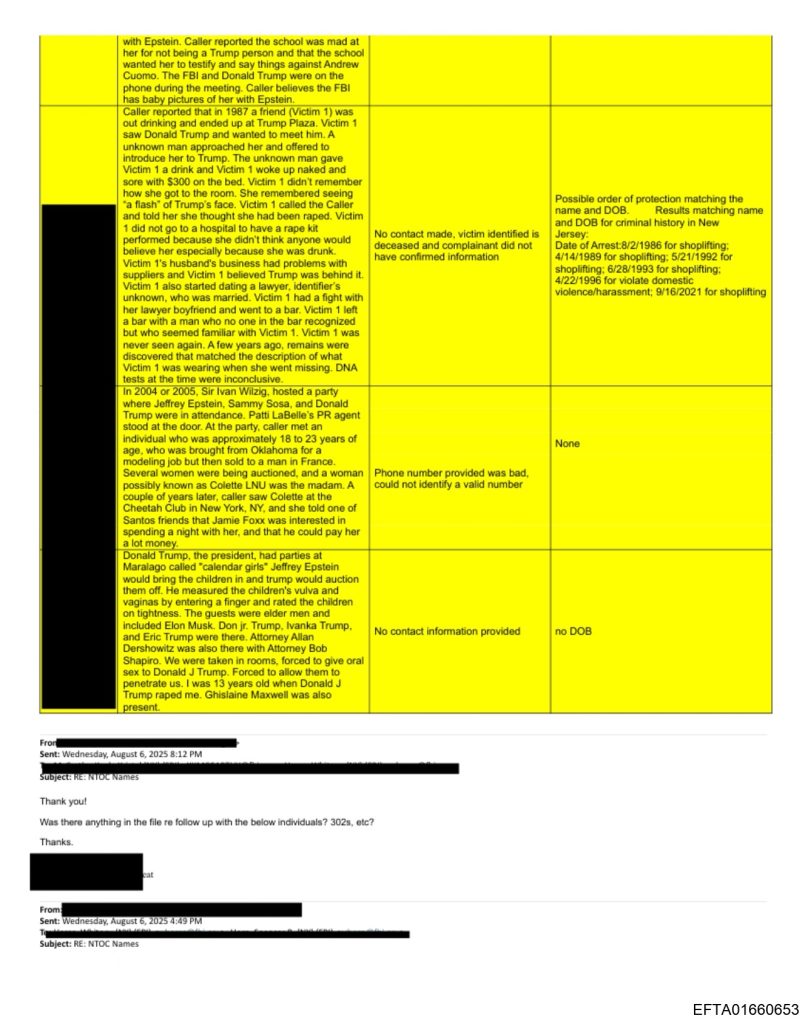
The report alleged that President Trump hosted “calendar girl” parties at Mar-a-Lago, during which he would auction children off based on measurements and ratings of their genitals. The individual claims that children were forced to perform oral sex on Trump. They state that they were raped, including by Trump at the age of 13.
It named multiple other prominent figures, some of which were included in the tracked searches: Don Jr., Ivanka, Eric Trump, Elon Musk, Maralago (spelled “Maralago”), Allan Dershowitz, Bob Shapiro, and of course Jeffrey Epstein and Ghislaine Maxwell.
To ensure the file was truly removed, I searched multiple words and phrases from within the document, but it was just… gone.
Update: This document was later restored. When comparing the original and restored versions, the only change was the addition of two small black-box redactions over the latitude and longitude fields on the last page. Everything else stayed visible, including the full IP address, city, region, postal code, and timezone.
A note on the redaction
Due to the language, I initially misunderstood how much information was contained in the document. I had assumed “remote IP” meant that the report was created while a VPN was in use. During my research I learned that my understanding was incorrect.
The latitude and longitude values were derived from the IP address in the same document. It’s an IPv6 address registered to a mobile carrier, not a VPN or proxy. The coordinates aren’t GPS data from the device used to create the report. They’re location data based on the IP, which places the submission within an estimated location at the time of the report.
This matters because the IP address was not redacted. It’s still visible in the restored document, and anyone can look it up. They could find the current estimated city, region, postal code, and rough coordinates connected to the IP. The redacted coordinates are a just more precise version of the same information that was left in view.
The redaction of the coordinates, and only the coordinates, protects nothing that isn’t readily available from the data that was left untouched. If location information should be protected, the remaining traceable information shouldn’t have been left visible. If not, the document shouldn’t have been removed.
This creates the appearance of a protective measure without functioning as one.
I initially didn’t know that the IP was the source of the location information, but it wasn’t hard to find out after the redactions drew my attention there. Whether there’s an internal misunderstanding of how location data works, or something else, isn’t fully clear. Either way the effect is the same: the one thing that was redacted is the one thing that was essentially redundant.
Internal emails referencing deleted files
Still, searching words and phrases from the document was useful in an unexpected way. After some digging, I found something that referenced the report: internal FBI emails.
The emails are dated August 6-7th of 2025. The subject line is NTOC names.
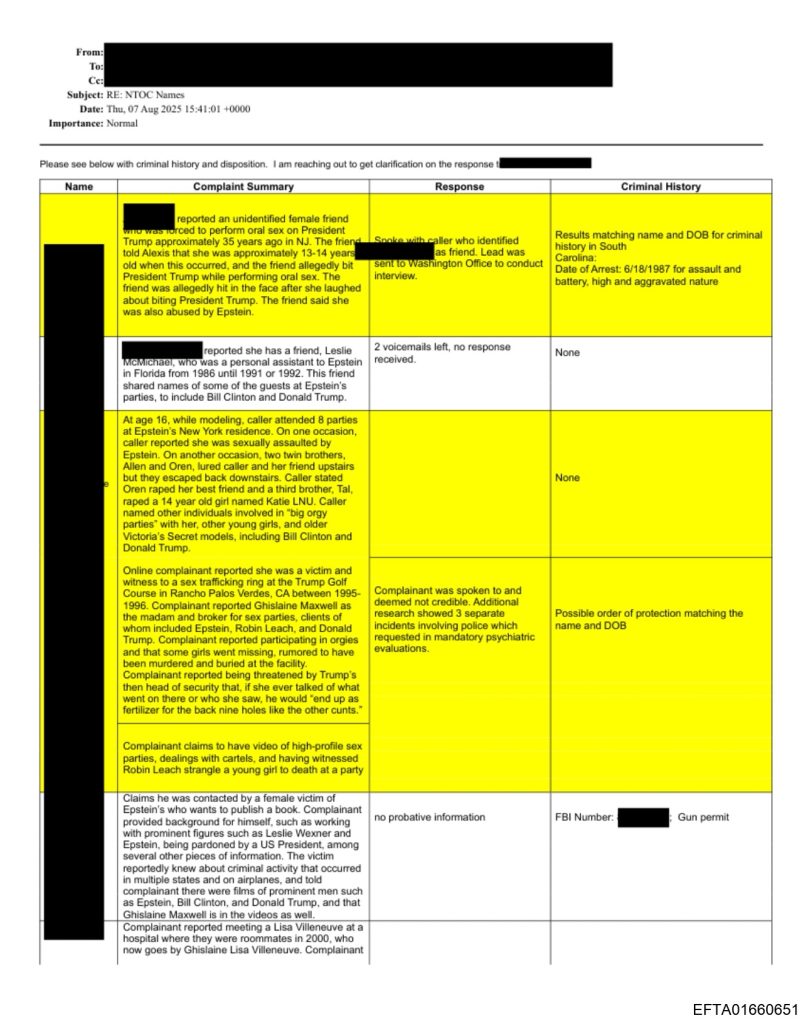
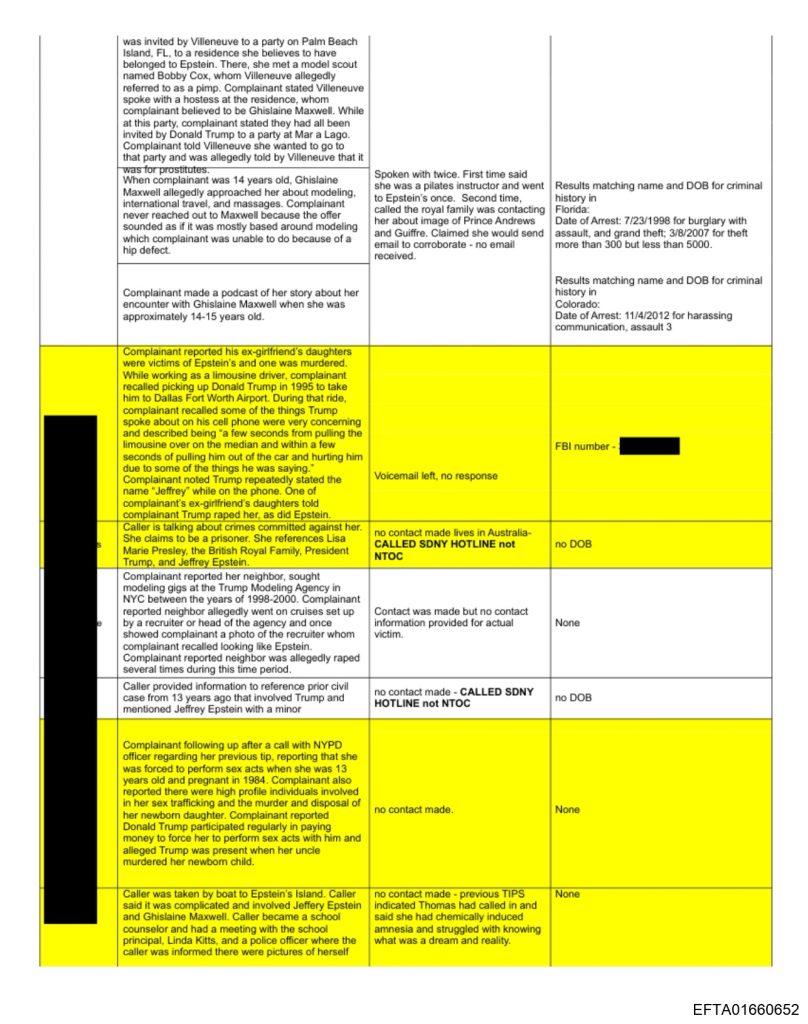
EFTA01660651
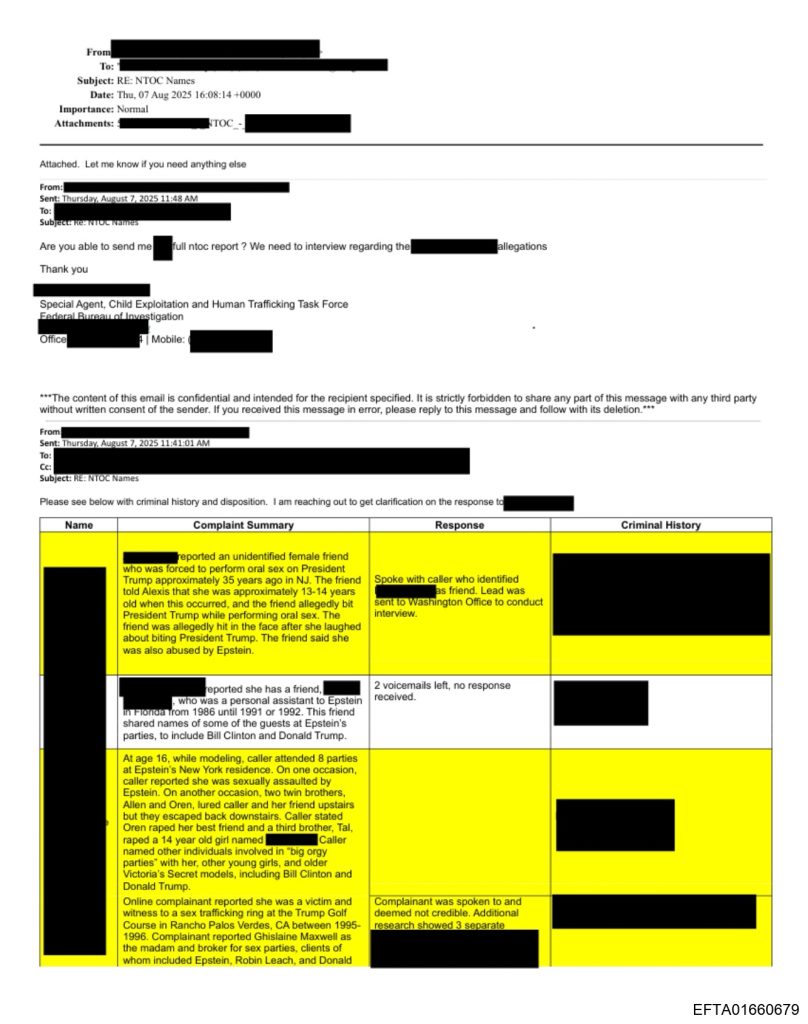
EFTA01660679
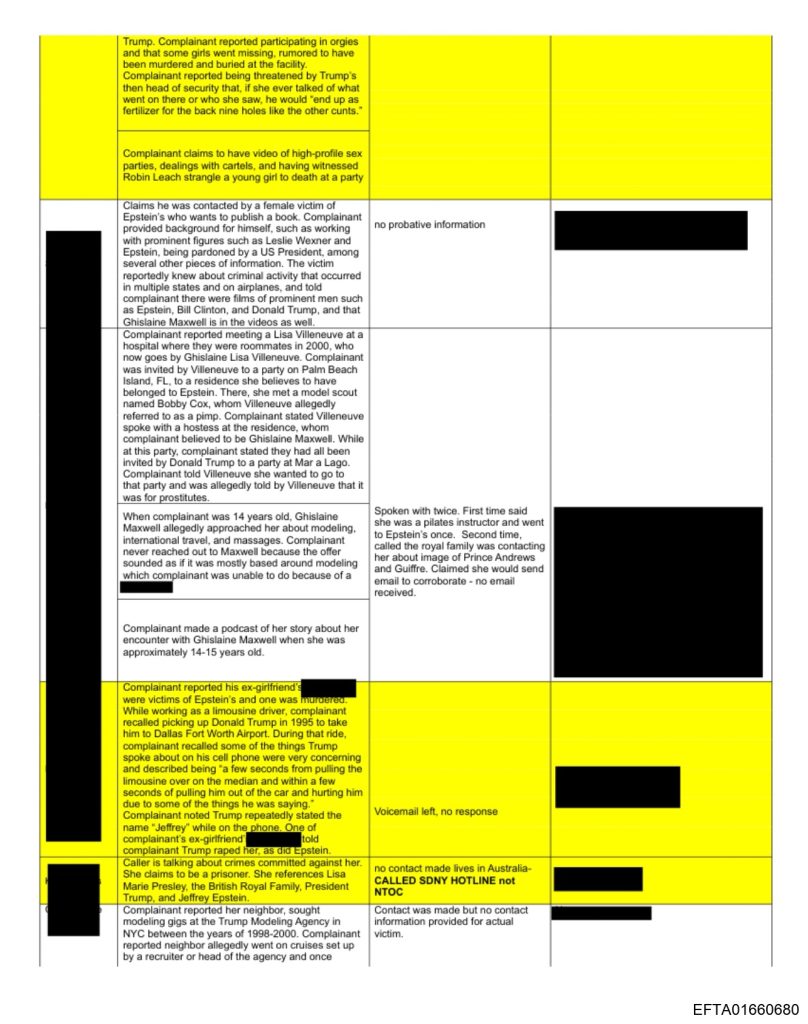
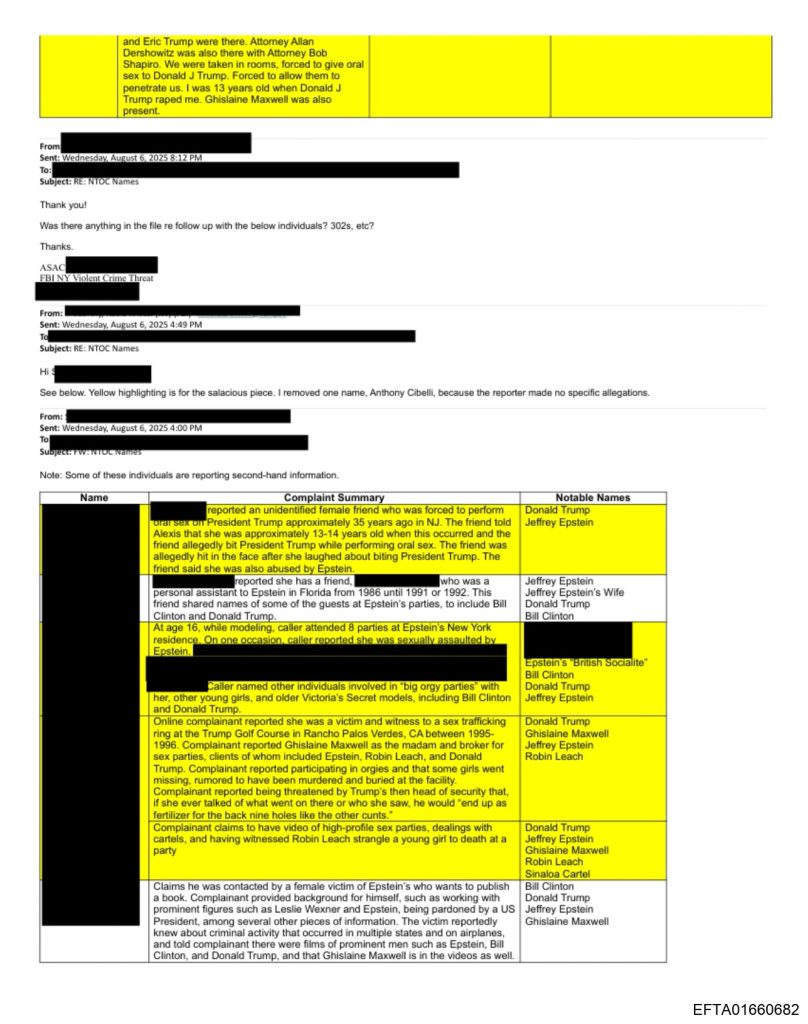
The first email is a list of redacted names with a note stating that some individuals were reporting second-hand information. In the second email, the list has been forwarded with a statement saying, “This is the list I sent Whitney with names of Trump accusers from NTOC.”
They aren’t referred to as witnesses, informants, or victims in a child trafficking case. Just “Trump accusers.”
By the third email, a spreadsheet is added. It has columns for each tipster’s name, complaint summary, and notable names mentioned in their report. A fourth email updates the spreadsheet with yellow highlighting to mark the “salacious” tips. One name was removed because the reporter made no specific allegations.
The fifth email asks if there is anything in the file regarding follow up with the individuals who made the reports.
This question is answered in the sixth email, in the form of an updated spreadsheet. In this version, the notable names column is removed. New columns appear for noting response, and the individual’s criminal history. Many of the individuals were not contacted. Nonetheless, their criminal history was researched and included.
The next two emails are only included in the later file.
An agent in the Child Exploitation and Human Trafficking Task Force requests a full report and mentions needing to interview someone regarding allegations. The response email contains the requested report as an attachment. However, the attachment referenced is not contained in the file. Based on a separate document (EFTA0166067), the allegations were likely against “Alexander brothers.”
Overall, the emails and spreadsheets were heavily focused on adding the criminal history and disposition of tipsters. It’s unclear whether the claims within the tips were ever investigated.
Out of the two versions of these internal emails, one was more redacted than the other. The variations in redaction are most notable in the spreadsheets.
Spreadsheets and redactions
Of the roughly 14-15 tipsters, 6 are noted as having no criminal history at all. 3 more found no results. That’s already the majority of tipsters.
Out of those who did have records, most were minor or decades old. Some include shoplifting, protection orders that may or may not match. The spreadsheet doesn’t distinguish whether the history belongs to the tipster or, in second-hand reports, the victim they identified.
EFTA01660651 includes the criminal history column almost entirely unredacted. In this file, it’s clearly shown that most tipsters had no criminal history. Of the few who had charges, the severity and age of the crimes are present in most cases.
By contrast, EFTA01660679 has black-box redactions covering the entire criminal history portion.
If someone were to find only this document, it’d be impossible to know that most of the tipsters had clean records.

Missing reports
Many of the referenced original reports (which were once public) were deleted in February.
This couldn’t have been due to the names of reporters being included, as even reports that had already redacted names were removed from public view. Based on the court order and transparency act, I couldn’t determine why the reports would’ve been removed.
But based on the FBI emails, I wondered if criminal history was used as a measurement of validity. Even though this reasoning wouldn’t qualify files for deletion, I checked into the potential criminal reasoning.
I looked at both types of tips: those noted as with and without a criminal record. The results showed that reports were disappearing even when the sources hadn’t been known to commit any crimes.
The inclusion of criminal history was still odd to me. So I looked further into it. I checked on the described criminal history in cases that I was able to research myself.
This is just one aspect of the mass removals that I was able to find, but it may give context on why this is happening.
Researching criminal history
I tried to determine and verify what exactly was found for criminal history. The process was strange.
Case 1
(Update as of March 5th: This is referencing EFTA02858497 which is now currently available.)
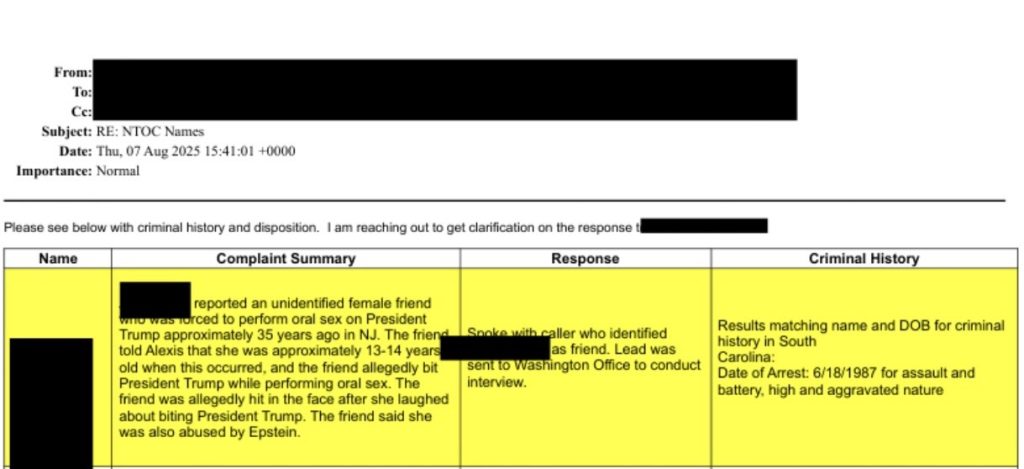
The complaint summary shows a tipster reporting that a friend was forced to perform oral sex on President Trump approximately 35 years ago in New Jersey, when the friend was 13-14 years old. The friend said that she was also abused by Epstein.
Context: the response column states “Spoke with caller who identified [redacted] as friend. Lead was sent to Washington Office to conduct interview.”
Due to the response notes, I interpreted that the victim had been identified. A lead on the report was then sent off in order to get an interview from said victim. This muddies the waters on who the criminal history pertains to, though.
To determine whether the investigation of criminal history was about the reported victim or the tipster, I analyzed with what information was available.
Step 1: Timing.
- The email is dated in 2025.
- The report is referring to ~35 years ago = ~1990
- It states the victim was 13-14 years old.
- This would make their DOB around 1977.
Step 2: Cross-referencing.
- The criminal history and disposition column states:
- “Results matching name and DOB for criminal history in South Carolina:
- Date of Arrest: 6/18/1987 for assault and battery, high and aggravated nature”
This criminal history includes a single crime in the 1980s, with no criminal record since then.
I tested my initial assumption that the criminal history was about the victim in the report (due to the response information about the lead). However, my assumption clearly couldn’t have been the case.
This would mean that the victim committed assault and battery at only about 10 years old.
Even if we slide the timeline backwards, as many reports were made from 2020 onwards… the victim still would’ve been a child, and located in New Jersey around that time.
It became clear that they were noting a decades old crime from the tipster, not from the lead they were preparing to interview.
This has impacts on perception.
Since the tipster’s criminal history was included next to the claim, this would be difficult to distinguish initially. To some viewers (especially in cases where criminal history is redacted), it may even appear that the report itself was questionable.
This is one example where it was possible to differentiate who the criminal history belonged to. Many second-hand reports don’t have enough information to allow that clarity.
Case 2
This is another person on the list of “Trump accusers” that’s noted to have criminal charges.
There are three reports that appear to be lumped together under the same name. The reporting name, response, and criminal history columns are merged.

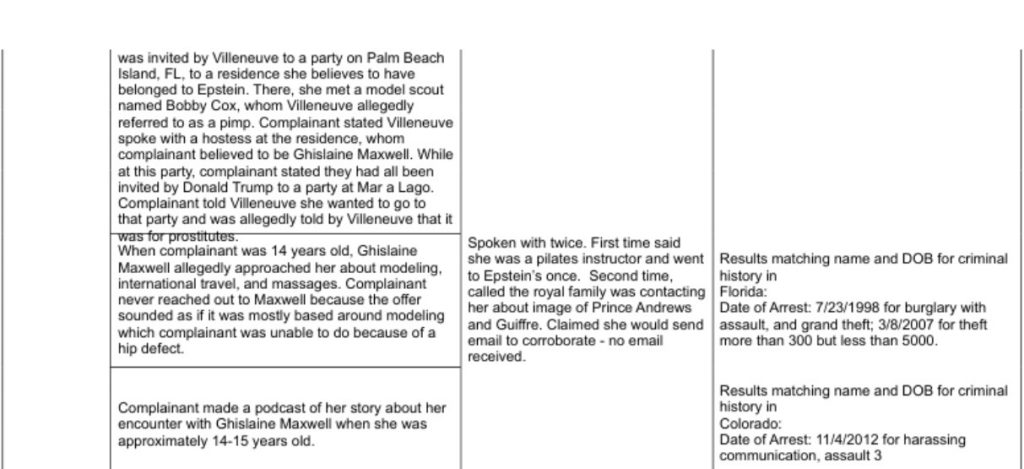
The three reports describe a complainant who was approached by Ghislaine Maxwell about modeling and massage when she was 14 years old, was later invited by a friend to what she believed was Epstein’s property on Palm Beach Island, and was told an after party at Mar-a-Lago was for prostitutes. She later made a podcast about her past experience when Ghislaine Maxwell approached her as a teen.
Findings: Using context and the details available, I was able to find the source of the reports. She has spoken about this for quite some time, and the details she’s provided publicly verified that the reports are from the same individual. She testified before the House Oversight Committee via Zoom in September 2025, and released the video footage herself in January of 2026.
During my research, I stumbled upon a link to a 2020 tip: EFTA00020508. The tip was speculated to be from her. It was in the publicly available files at one time, but when I originally clicked the link, it appeared to have been removed. (Update as of March 5th: The file has been restored. I am unsure whether any further redactions have occurred.)
There is some controversy around her online regarding denials of other known victims’ claims. That said, controversy on the internet is not listed as a reason to remove documents.
Despite the criminal information the FBI compiled, I couldn’t verify either of the state records they listed. That doesn’t mean that the noted criminal history doesn’t exist, just that I wasn’t able to find it.
Either way, a claim isn’t proven true or false by examining whether or not any past crimes exist.
And even if reports aren’t found to be true, that still wouldn’t qualify them for removal.
There are reports in the Epstein library that note when claims have been investigated and deemed unsubstantiated. If that were the case, it should remain accessible, just as others have been.
The timing
In many cases, deleted documents didn’t contain the names of trafficking victims. Even the change to restored file EFTA01245100 did essentially nothing. The redaction kept the source of the location information available: city, region, and arguably the most identifying piece of information, the IP address.
This makes the reasoning questionable, as it doesn’t appear that known standards and requirements have been the cause.
The internal emails show that those who came forward were actively labeled, categorized, and researched personally based on who their reports named.
Without having transparent reasoning, the internal emails reflect the same implications as the mass deletions.
Not only that, the timing makes it harder to dismiss.
On July 24-25, Ghislaine Maxwell was interviewed under a proffer agreement. The interview was conducted by US Deputy Attorney General Todd Blanche, who was also formerly Trump’s personal criminal defense attorney.
During the interview, Maxwell said that Donald Trump had not done anything inappropriate. She also said that she didn’t recall any note or drawing from Trump being included in Epstein’s 50th birthday book. Interestingly, Blanche clarified that he was referring to what she remembered from the discovery documents when she answered the question.
One week later…
On August 1st, Ghislaine Maxwell was transferred to Federal Prison Camp Bryan in Texas. This minimum-security facility is typically for nonviolent first-time offenders. The Bureau of Prisons confirmed the transfer but didn’t give reasoning.
Normally BOP policy doesn’t allow sex offenders to be placed in minimum-security camps due to public safety risks. In this case, a rare high-level waiver was authorized which allowed Maxwell to transfer. Former BOP officials have stated that over decades of experience, they’ve never seen a case like this happen.
Maxwell still has over a decade left of her sentence. Upon arriving, she emailed her friends and family about how much better the new facilities were. Reports have claimed that Maxwell receives special treatment and privileges at the facility.
Days later…
On August 6-7, the FBI compiled lists of “Trump accusers” to investigate, citing “salacious” claims. Time and resources were spent collecting criminal history, without visible indicators of whether the information within reports was thoroughly investigated.
All of the above events occurred within a couple of weeks.
Now…
Orders for release were violated and delayed. Upon release, the public noticed a stark contrast in the level of care for victim protection and those with prominent names. Evidence from the public files has been deleted continually.
Regardless of what the disappeared documents imply about guilt or innocence… the act of deletion is still a breach of public trust. Removals have clustered around powerful names without transparent justification. Meanwhile, internal processes appear to prioritize sorting witnesses over investigating their reports. It’s especially concerning at this scale.
The restorations that followed public backlash reinforce this pattern. Documents came back because people noticed and said so. That mechanism only works if people keep watching.
The pattern isn’t subtle. Beyond the implications, there’s something even more important.
Our response to this matters. It was only through collective demand that any of the files were made public. It was only after public outcry and congressional hearings that files once-deleted were restored. Our awareness is one of the most powerful tools we have.
Even when transparency is lacking, patterns can’t truly hide. Materials are available to examine. Archives are available to see and share. Removals are traceable pieces of information in themselves.
As we continue to notice inconsistencies, we should use our voices to question them. We should think critically about what these actions point to, and what that means about the systems perpetuating it. We are witnessing something that requires us to not fall silent.