
“Transparency” feels more like PR.
I noticed the deletions by coincidence. On February 1st, I searched “Musk” in the publicly released Epstein case files and noted the result count. When I checked again later, the number had dropped. Once I noticed that, I started tracking it. “Musk” was tracked for 10 days with multiple observations per day. After a couple of days, it expanded with 26 additional search terms tracked daily. The deletions seem to reveal something about how the government is deciding what stays public vs what -or who– is protected.
Officials had previously stated that some materials in the files were unsubstantiated, but were still released because of the court order. They also claimed that removals would be done to protect victims. In reality, there’s been a consistent pattern of redacting unfavorable information tied to prominent figures while leaving victims exposed.
The big release was no different. After months of noncompliance with the court-ordered deadline (which they claimed was due to redacting files for victim protection), the released documents still contained criminally explicit material of victims, which was only removed after the public had already seen it.
Even with what appears to be an effort to censor information in favor of alleged perpetrators, many unflattering files have continued to be deleted.
Given that the majority of the terms I tracked are clearly not victims of Epstein, the consistent deletions of results are telling.
If certain names are attached to compromising material of victims, that itself says something.
And unless the files being deleted are explicit images… why not simply redact the victims’ identities and leave the rest intact?
Why remove entire documents that happen to contain the names of prominent people?
The Tracking Data
Various terms were tracked and observed, with some being related.
Daily Tracking of Multiple Search Terms
First, the daily counts.
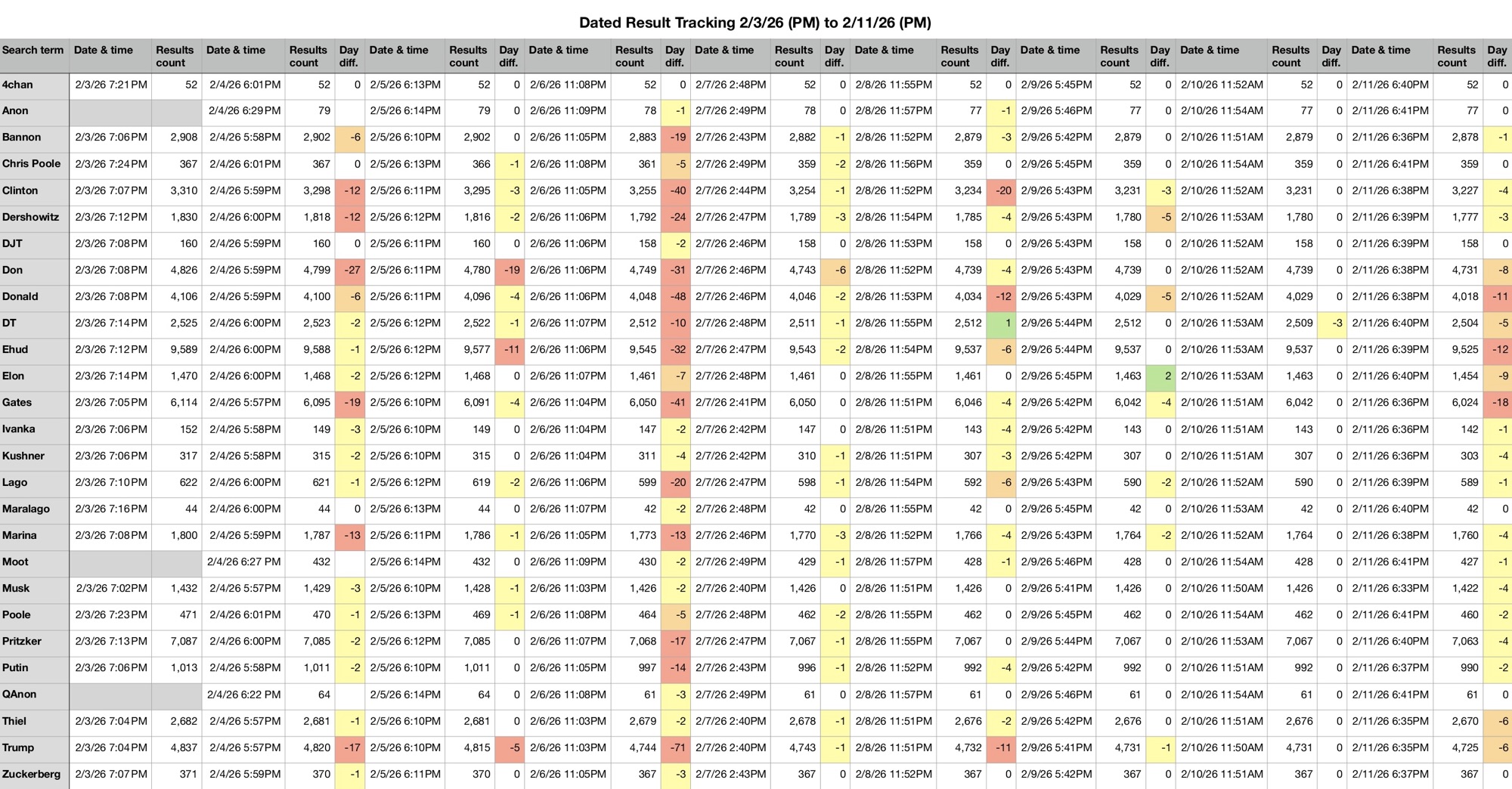

Keep in mind that the results for “Musk” are limited to the time period of February 3rd through February 11th in this spreadsheet. There were earlier observations, though. The expanded results for “Musk” will come later.
Additionally, there were three searches that were tracked for 7 days rather than 8. These terms started being tracked February 4th, and so the date and count columns for February 3rd are grey to reflect that difference.
More importantly, the deletions somewhat correlate across search terms. For example, nearly every search term had its sharpest drop on February 6th. What would’ve caused that mass deletion event?
On top of that, related names have drop correlations, which helps narrow down what exactly is being removed.
One example of this is the fluctuation in the terms “Poole” and “Chris Poole.” For all but one day, the terms were either stable together or dropped by the same exact amount. This example shows us that out of the “Poole” results, it’s specifically “Chris Poole” that’s being removed from the Epstein library.
Overall Deletion Stats
The overall totals are below.

Terms with the largest absolute declines:
“Trump” (-112), “Don” (-95), “Gates” (-90), “Donald” (-88), and “Clinton” (-83).

The percentage declines tell a different story, due to differences in the baseline number of results:
“Ivanka” lost 6.6% of its results, “Lago” lost 5.3%, “QAnon” (7 days observed) lost 4.7%, and “Maralago” lost 4.5%.
This makes for high removal rates relative to their smaller baseline count.


The Earlier Deletions
Circling back to what started all of this for me, the term “Musk” had earlier observation points. The expanded view is below. It includes the earlier observations, and in some cases, multiple observations within a day.
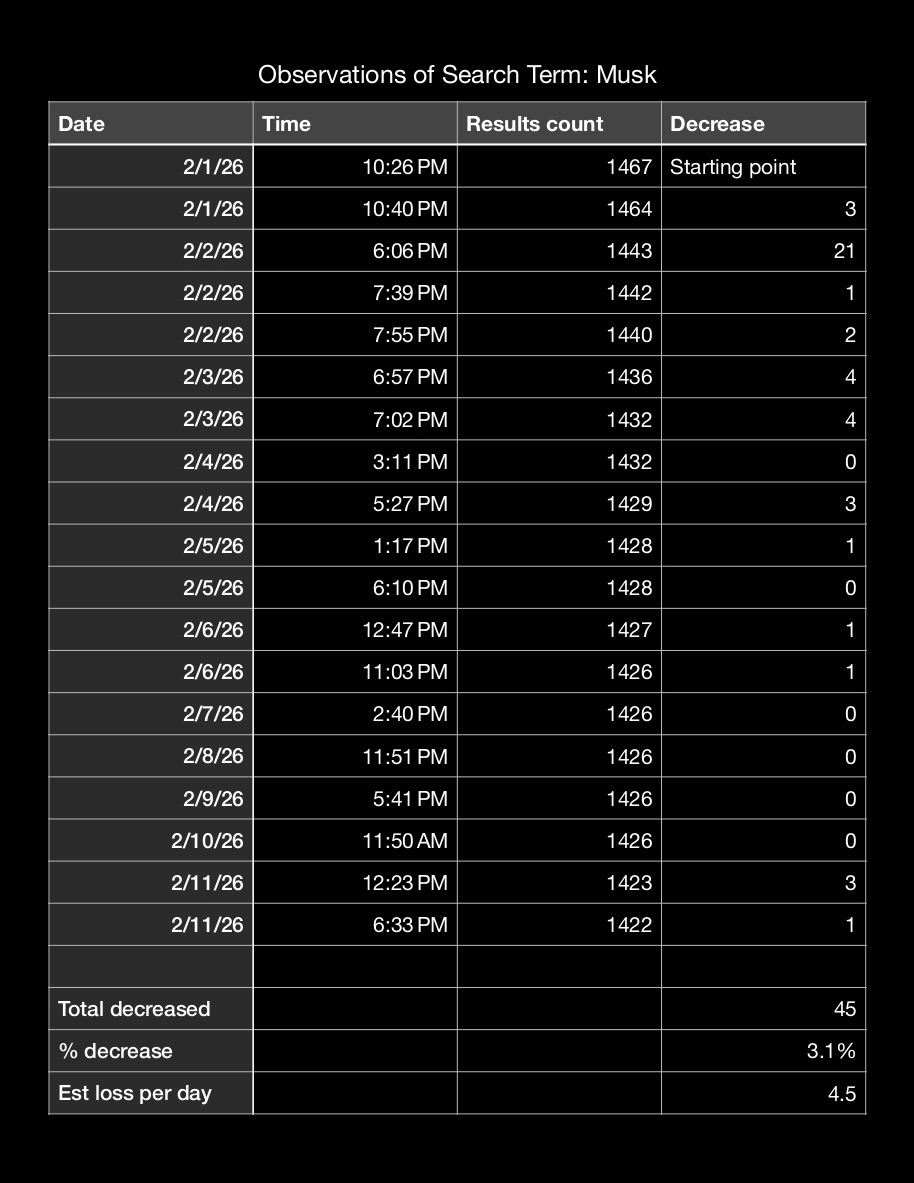
The “Musk” result tracking started a couple of days earlier, and it showed a steep drop early on:
from 1,467 to 1,440 between February 1st and 2nd.
This was a loss of 27 results in less than 24 hours.
The decline then slowed down, plateaued at 1,426 for four days (February 7 th-10th), then dropped again on February 11th.
Cross-Referencing
The multi-term tracking showed that large drops correlated across search terms.
Based on what was observed across searches, I am almost certain that other terms also dropped even more dramatically than the February 6th decline (when nearly all terms dropped).
Unfortunately though, I only observed one term’s result counts before February 3rd. I can only make educated guesses on how many removals there would’ve been for the other terms before I saw them.
Why?
While I watched the numbers fall, I kept thinking about why.
What is in the files being removed? And why is it causing the names of prominent people to disappear from public view?
At first, I could only guess what types of files were disappearing.
But after the last results were tracked, I ended up finding an example of what was deleted from public view.
The first document that I decided to check on had been deleted. It was a document I had saved on February 2nd… wiped from the Epstein library a week or so later.
Finding that example led to another. I’m currently compiling the information.
One response to “Tracking Mass Deletions of the Epstein Files”
[…] Previously I noticed that results in the Epstein library were dropping for certain search terms. I wondered why. What was in the files being deleted? Removals were supposed to protect the sensitive information of those who were victimized in the case. My tracking seemed to show a different pattern. Many files containing powerful names were being removed from public view. […]