
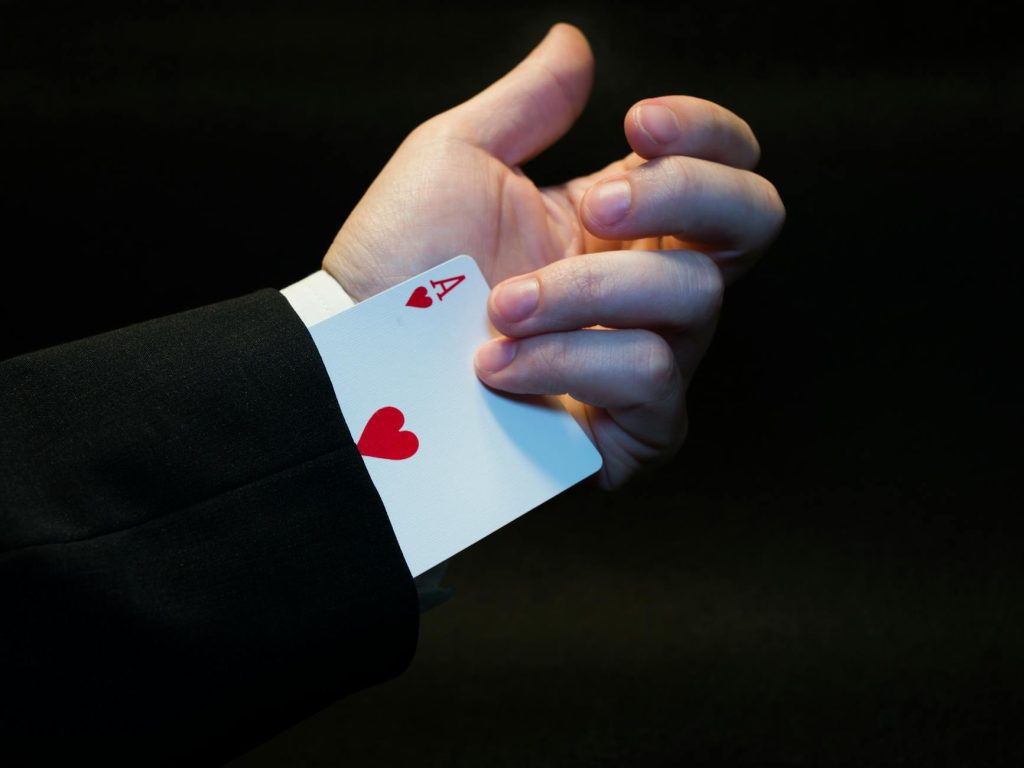
When there is no way through, there is often a way around.
The world is rarely as simplistic as we make it out to be. Black and white concepts of good and evil lack the actual depth in the world (and the people within it). We don’t have to live in the polarities of one vs the other. And we shouldn’t. We’re both ends, and all sorts of things in between.
The Trickster understands this wholeness, living in full spectrum color while everyone else argues about right and wrong. Tricksters survive and thrive. They shift their forms, and in turn, alter others perceptions. They’re a transformative force to be reckoned with. The changes they initiate can be swift, chaotic, and sometimes destructive. And surprisingly, even in deception, they also embody truth.
Ancient Myth
Traditional tricksters embody both ends of duality. They break the either/or framework and act as both heroes and villains in their stories. With their wit and cunning, they challenge the truths we accept, and the rules we live by. They’re not afraid to pull the rug out from under us and expose the cracked foundations we’ve ignored.
Modern Myth
Current tricksters could be fictional characters, or even real-life people that challenge our flaws and contradictions. Many of them are labeled anti-heroes or rebels. They question authority, expose corruption, and drive change. Often times, they have strong core values, and questionable methods.
The trickster is complex and multifaceted. They embody our shadows, challenge our beliefs, and force growth.
Jungian Concepts
The trickster can be an aspect of Jungian shadow, an unconscious archetype. It holds polarities with ease, like wisdom and foolishness, good and evil. The Trickster’s fusion of opposites catalyzes growth and change.
“He is a forerunner of the saviour, and, like him, God, man, and animal at once. He is both subhuman and superhuman, a bestial and divine being, whose chief and most alarming characteristic is his unconsciousness” – Carl Jung
The Trickster Alter-Ego
Most of us despise trickery. But the trickster isn’t removed from us, and it’s not just a character trope. Like many other archetypes, it’s a part of our psyche. Everyone has a bit of a trickster within them. We might even think of it like an alter-ego that surfaces during sticky situations. The trickster part of ourselves helps us get creative with how we face the music.
“One does not become enlightened by imagining figures of light, but by making the darkness conscious.” – Carl Jung
At times we all have tendencies toward mischief and rule bending (or rule breaking). When we embrace that part of us, we open ourselves up to a world of possibilities.
We start to see the rigidity of the internal beliefs and collective structures we’d once been comfortable in. This growth gives us the resilience and motivation to change it. And as we break free from ourconstraints, we can suddenly see the open roads we’d never noticed before.
The trickster is like a mirror. It shows us what needs to change through our own reflection.
“The trickster is the agent of transformation, the one who keeps the system in motion.” – Mark Doty
Lessons from the Trickster
Resilience and Adaptability (Loki, Mystique)
No matter what is thrown the trickster’s way, they will survive.
Loki is known for his pranks and mischief. He’s caused problems ranging from shaving a goddess’s head to offering gods up as payment for work. But from his tricks to fixing his mess, his tricky antics improve the lives of the gods. Sometimes it even provides some of their best weapons. Loki escapes consequences by thinking on his toes. He adapts his strategy, others perceptions, and in turn, the outcomes.
Mystique (X-Men) is a resilient trickster and cunning activist. Shapeshifting allows her to infiltrate and learn the secrets of enemy groups. The intel she gains keeps her a step ahead of their plans. While in those groups, she sabotages, deceives, and creates splits within them. Even in the face of danger, she transforms her identity into another’s and escapes those that threaten her. This trickery is effective not only for her goals, but for her to survive.
This resilience and adaptability reminds me of The Fool tarot card. It symbolizes a new start, potential, and the foolishly brave aspect of optimism.
“The Fool is the spirit in search of experience” — Rachel Pollack
Initiating Change (Coyote, Robin Hood, Technology)
The trickster adapts and creates change. Even when it doesn’t go exactly as planned, their hands are the creative spark that ignites it.
Coyote is a god within multiple Native American cultures, though the stories vary. In many, he’s a divine creator who gifted fire to the world. This positive side ripples out through all of humanity. He’s also a mischievous god who overestimates himself, and selfishly overindulges. Those qualities reflect very human traits and their negative impacts are made clear. Both the positives and negatives show the widespread chain reactions that can come from our actions.
Robin Hood is another example of a change-sparking trickster. Robin Hood is an (active)ist. As he steals from the rich and redistributes it to the poor, his values are expressed in action. With this, he directly fights inequality on philosophical and physical fronts. The changes that come as a result impact the minds and lives of the people, and the system that oppresses them. Though they operate differently, both tricksters highlight morals and spark change.
The trickster also lives in fields that drive rapid change, like technology. These fields are innovative, swiftly pushing forward and outward, refusing limits and bounds.
“The best way to predict the future is to invent it.” — Alan Kay
This aspect of the trickster brings to mind The Magician tarot card. It relates to resourcefulness, mastery, and the power of bending reality to their will.
“The Magician is the archetypal trickster, transformer, and catalyst” — Sallie Nichols
The Power of Intellect, Wit, and Cunning (Anansi, Odysseus)
Tricksters are creative thinkers, and often underestimated. Through their calculated actions, they fly under the radar of detection.
Anansi is a great example of this tricky trait. He’s a god that typically takes the form of a spider, making him much smaller than those around him. Though others may be stronger or larger physically, Anansi surpasses them mentally. He communicates in facts, stories, and misdirections, all cleverly woven for his goals. Through his wit and intellect, he’s able to outsmart even the most intimidating creatures. Not only that, he might even convince them to do his bidding.
Odysseus (Homer’s epics) displays this too. Though he was made to join the war against his will, he channeled his cleverness into the Trojan horse. This deceptive strategy ultimately won the war, and is a theme he consistently embodies. At every turn during his long journey home, his mind was his saving grace. He managed to survive the wrath of Poseidon and the deaths of his entire crew. His lies, deceptions, and often brutal strategies created possibilities out of impossible situations.
“The trickster is the embodiment of the energy of the life force. He is the impulse to do the unexpected, to break the rules, to create change.” – Joseph Campbell
The Importance of Humor (Anansi, Deadpool)
Humor is timeless. When we add laughter to the mix, hard lessons and truths become easier to absorb. Tricksters are masters at this, their jokes and pranks can hold surprising wisdom.
On top of intellect and cunning, Anansi also excels with humor. In his stories, he often mimics and teases the ones who fall for his tricks. He takes a playful approach, and through laughter, effectively flips the script. Irony comes into play in both his clever plays on words and the funny ways scenarios backfire.
Deadpool has also mastered humor. Being an anti-hero trickster, his humor leans sarcastic, ironic, and dark. Breaking tension, he finds a joke in even morbid moments. People can laugh at his sarcastic meta comments, while also recognizing the issues and morals he touches on. This chaotic energy makes him effective at rebelling against authority and exposing its ridiculousness.
Humor cuts through the heaviness of situations. It’s impactful in how we learn, observe society, and cope with life. Tricksters remind us of the value of light heartedness as we learn and grow. After all, it’s much easier to accept the need for change when the criticism is packaged up in our laughter.
“Humor is the most significant activity of the human brain.” – Edward De Bono
The Value of Perspective (Hermes, The Mask)
The trickster isn’t bound by ideas like conventional morality. They embody the wholeness of perspective, within and without the spectrum.
Hermes is a divine messenger and a god of intellect. He guides humans, providing them with knowledge and wisdom. While these are aspects of Hermes, he is far from restricted to them. Shortly after his birth, he stole from another god and covered his own tracks. As a god of theft and trickery, he protects thieves. While he may help or guide, he may also protect and conceal the one behind the issue.
One of my favorite movies growing up was The Mask, and the mask itself is its own trickster character. It removes inhibitions and reservations, and gives extreme power to whoever wears it. The wearer gets transformed into a chaotically drastic version of their inner self, which can contradict the ways they typically act. In itself, it’s neither good nor evil.
Tricksters accept complexity and embody the wholeness of human behavior, contradictions included. They push us to let go of our assumptions and restrictive mental boxes. The trickster sees with a fresh perspective: outside of our constraints, often with many sets of eyes. Nietzsche’s concept of perspectivism flows with this aspect, as there are many lenses we can use to make sense of the world.
“There are no facts, only interpretations.” – Nietzsche
Liminality (Beetlejuice, Hermes)
In some way or another, tricksters have a trait of liminality. They are neither here nor there, always changing form and occupying the in- betweens of boundaries.
There’s some overlap with this. Tricksters like Loki and Mystique are clear physical representations. Their liminality is shown tangibly, as they shift their identities and change their appearance without bounds.
Another lens is through abilities to travel through and beyond external boundaries. Beetlejuice (the movie) is in itself highly liminal. And the character Beetlejuice personifies it. He exists in an in-between plane, but that doesn’t stop him from interacting with and breaking through to the physical world.
Hermes is another example. Among his many abilities, he can also swiftly move through different planes of existence. This makes him a great messenger, as he can quickly reach anyone, anywhere. It also makes him an excellent psychopomp. Hermes crosses bounds naturally as he guides souls from the earthly realm to the afterlife.
“Trickster is the mythic embodiment of ambiguity and ambivalence, doubleness and duplicity, contradiction and paradox” – Lewis Hyde
Exposing Loopholes and Questioning Structures (Eris, Set, Hacking)
Tricksters expose flaws in our thinking and our systems. They use their skills to find and exploit weaknesses for their benefit.
Although not always thought of as a trickster, Eris, the goddess of discord and strife, definitely shakes things up. In her story, she set a perfect trap for the gods. After being excluded from a wedding, she decided to highlight their hypocrisy. She offered the prize of a golden apple to the goddess voted most beautiful. Divine pride and vanity drove the dramatic conflict into bribery, and even resulted in the Trojan War.
Set is a complicated god who also has similarities. After tricking and murdering the reigning god Osiris, his antics resulted in the birth of Horus. The two fought constantly, and represented the balance between order and chaos. Despite being a violent god, he also protected Ra, was admired for his strength, and many were even named after him. Opinions about Set have changed and morphed with the times. But the fact remains that chaos is a means to challenge order.
“Disobedience is the true foundation of liberty.” – Henry David Thoreau
Currently, hackers strongly embody this trait. Even the most advanced, safe, or secure systems have real vulnerabilities. Hackers find them, and infiltrate those tiny cracks we hadn’t noticed. Overall, this serves a positive cause, as it shows us the truths we neglected and pushes us to improve. Plus given our varied motivations, there are many hackers who use their talents for activism and positive change.
“Zero-day exploits are a double-edged sword. They can cause significant harm, but they also highlight weaknesses that need to be fixed.” — Bruce Schneider
Tricksters raise hell. They make us face our stagnation and chaotically shift our thinking. Their destruction makes us rethink how well our systems were built in the first place. In this way, The Tower tarot card comes to mind. It represents the swift leveling of structures that aren’t strong enough to stand. This is an ultimate reality check, proving that the things we lost weren’t truly solid. And after The Tower, we can rebuild better and stronger.
“The trickster’s function is to break taboos, create mischief, stir things up. In the end, the trickster gives people what they really want, some sort of freedom” – Tom Robbins
What Might the Inner Trickster Say?
Our inner tricksters have ideas, perspectives, and strengths that can help us if we let them. We’re all contradictions in one way or another, the trickster makes that painstakingly obvious. Becoming conscious of it is part of integrating our paradoxes. Our inner landscape and the outer collective are always changing. We are not simply one thing or another.
“In a time of drastic change, it is the learners who inherit the future. The learned usually find themselves equipped to live in a world that no longer exists.” – Eric Hoffer
Leave a Reply