
Interpersonal Potentiality Pt. 2

Initially, I’d learned that potential was present and alive, but I had focused on the personal, exciting pieces of it. This framework started from learning something new that impacted that past understanding.
The interconnectedness of potential is reflected in everyone. Unfortunately, abusive relationships have some of the hardest effects. This is close to my heart, it’s the core that spurred the whole understanding.
Part 1 covered the basic updated framework.
Part 2 focuses on abusive relationships and trauma, using the framework as a lens for understanding.

Real, complex potentials
It could be possible that all potentials exist within a person, but on a scale. With a scale so varied, some things might never even come up. Some might be major potentials, others might be smaller.
There’s a part to this that gets difficult in abuse dynamics. Not all potential is positive. Not all potential is chosen.
And when it’s not you that chooses, it’s even harder to evaluate it.
The potential within the one who harms
Both good and bad polarities exist within an abusive person, and both are real, but oftentimes their darker side outgrows their light.
It’s easy to hold onto glimpses of good parts in another. We might even hold onto memories when they embodied their positive potential, a potential that’s truly there.
It’s human to wonder why they act in their worst potential, and wish so badly that they’d choose differently.
We might want to understand, nurture, and guide them back to their brighter self. We may have spent our time and energy doing so, and feel hurt if they don’t choose the good we know they possess.
But that’s not our choice, it’s theirs.
Choice matters and should be observed. The personal choice that comes after is a matter of truth and clarity.
At what point are we choosing a “potential” in another, rather than the potential they’ve chosen to become?

Examining origins and roots of abuse
Let’s move backwards toward childhood, the roots of our life experience.
Searching for the reason “why” can create thought loops without much clarity. So, we’ll deconstruct it. We’ll look at aspects thought to correlate with later abusive behaviors, and whether abuse itself might create the potential for it.
Inherent potentials
Our inherent potential is our innate baseline.
Though it’s a natural foundation, it can still be chosen, shaped, or even minimized. Some of these potentials might be easier to adjust than others. Maybe some children have higher potential for artistic talent, while others can grow it with active participation. Some may have higher natural potential in math, literature, and so on.
Getting into the deeper traits, inherent empathy is a powerful one to focus on. This is trait feels so deeply engrained that it’s hard to imagine a way to grow it in comparison. Its can also tie in with abuse. It’s worth exploring the role of choice in it, and how it might shape individual trajectories.
Inherent empathy
Empathy is on a spectrum. Even during childhood this spectrum can be seen. There are often clues of underlying disorders that relate to lower empathy levels. A lot of times, there aren’t external reasons or causes for it. On the opposite end, high levels of empathy often also present early on.
That being said, empathy is also a growable trait. It may require active attention, thought exercises, and/or therapy. Though our baseline might influence this, even those with lower capacities can work to grow it if they choose.
Inherent and circumstantial potentials
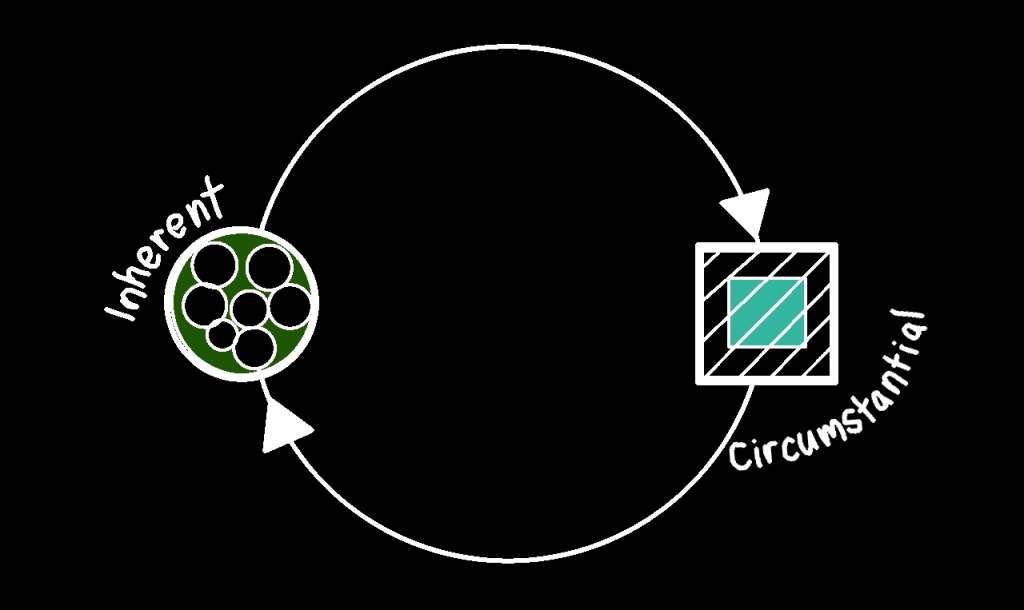
Chosen adjustments to potential come with chosen behaviors. But with a trait like this, it can get tricky. Comparing inherent and circumstantial potentials, we find that neither are absolute deciding factors.
Some with relatively normal circumstances may also have lower natural capacities for empathy. Some might harm animals, while others might never be violent toward any living beings. Lower empathy does not mean someone is destined to abuse.
Some may face traumas that increase their potentials for violence against others. A portion of those may act on them, another portion may not. Trauma does not mean someone is destined to abuse.
Both of these examples highlight choice, whatever the origin of the potential may be.
There’s a specific issue that tends to correlate with abuse in adulthood. A lot of times, childhood abuse is a shared circumstantial origin.

Variations in childhood abuse paths
Individuals can have very similar circumstances and become such different people. Even with the same set of childhood abuse circumstances, people can choose vastly different paths. We’ll focus in on three of them.
The Abuser:
Some might choose to reenact the ways they were victimized onto someone else, reversing the roles of their background.
The Vigilante:
Another portion may choose to stand up to or punish abusers, seeking justice and protecting others.
The Healer:
Others might choose to focus on helping those who faced abuse, offering understanding, affirmation, and needed safety.
Comparing variations
There seems to be some sort of core disposition that lends to those differences. Though inherent traits like empathy and others are likely involved, it’s not the whole picture.
Lower levels of empathy could skew higher possibilities to harm others, but this isn’t always the case. Other paths exist and are chosen by those with lower empathy levels.
And while a background of enduring abuse might create a possibility, that doesn’t mean it’s the only outcome.
Experience teaches that becoming an abuser is never justified, and that abuse is a choice.
There are likely several elements that affect how we respond to our circumstances and whether or not we become the worst of our experiences.
Choice is one of them, the ultimate one.

Choice in abuse
Choice is a complicated topic for those actively being abused. But when it comes to abusers, the pattern is much clearer.
While abuse is chosen by an abuser, it actively mutes and distorts the ability to choose in the other person.
Abusing another person is a choice.
Outside of relationships with those they harm, abusers are capable of perfectly normal actions and interactions. They’re capable of regulating behaviors in the presence of witnesses. They may time abuse, showing restraint by waiting until they’re clear of interference or consequence. Sometimes they might even sustain it in the presence of others by “quieting” it.
In this way, abusers strongly show the conscious ability to choose. Rather than choosing differently, they choose to ensure they can continue. Their priority is focused on flying under the radar of others around them.

Dissecting abuse narratives
When comparing an abuser’s chosen actions to the reactions of those facing it, we can see huge differences. One might argue that aggressive reactions to abuse make the reactor abusive. This is a narrative that abusers often utilize. It’s also one that survivors often internalize with deep misplaced guilt. It’s not only wrong, but harmful.
Trauma responses
Trauma responses aren’t premeditated aggression, but actively provoked by abuse.
It’s sort of like the uncontrollable reflex to jerk your hand away from a burning hot stove. It’s not a choice to harm, it’s survival instinct taking over as a result of abuse. This danger creates panic, the conscious mind becomes overloaded and the body takes over with fight or flight.
Trauma responses and reactive aggression also show another piece of imbalance in abusive dynamics. The reaction can feel like theft of personal choice. When active trauma reaches personal limits, the capacity to consciously decide how to react becomes impossible. This can cause strong feelings of guilt, and feel like a loss of self at the hands of the one who chose to harm.
The abuser chooses to abuse without being provoked or even prompted. Their abuse, in turn, is the strongest form of provocation for the other: danger.
There is a major difference between a choice to harm, and a reaction to harm.

Responsibility in abuse
The obvious factor is that abuse harms and negatively impacts the potentials of those who face it. Clearly, abusers are responsible for their choice to harm.
When it comes to the person on the receiving end, responsibility still exists. Given the difference in roles, it’s a different type of responsibility. It’s not stemming from the choice to harm, but the choices in the aftermath of another’s inflicted harm.
Responsibility in trauma
Sometimes the shock of a trauma response can feel like a loss of identity. It can also reveal a ton of truth. Trauma responses are far from the only way to gain awareness, and ideally this point would never be reached. But these are moments when the impacts are impossible to gloss over.
Examining this requires acceptance of the reaction without internalizing judgment, guilt, or blame.
We can only take so much before our bodies take over to protect us. At the point of trauma responses, the ability to cope and regulate has been severely injured. Reacting to active harm and danger does not make someone a bad person. But it does show the state of harm they’re dealing with.
We aren’t responsible for someone else’s harmful choices. We’re responsible for our own, and how we mold the potentials that have come from it.
Understanding the harmful impacts that led to the trauma response can open up other pathways of awareness. It can show how accumulated harm has impacted other areas of life and self. For many, this clarity helps motivate the beginning steps of change. Though we can’t change the abuser’s choices, we have the responsibility to choose what we do with the reality of it.
Aftermath
Let’s say that the abusive relationship has ended, and both parties have parted.
The relationship created painful circumstances that impacted the potentials of the one who faced abuse. 
For the person who faced the abuse:
What will they choose to do with their potential?
One worst case scenario might be falling into the patterns of their abuser, becoming abusive themselves.
Or they might process it.
They might reflect on what the experience brought out and diminished within them.
Becoming aware of the personal impacts, they also might contemplate how their potentials impact those they love and vice versa.
They might start to see a chain of effects in their connections.
With this path, healing and growth can be consciously chosen, with positive impacts for both self and others.
For the abuser:
Working backwards now, what might’ve been the origin of their choice to abuse?
Maybe they faced abuse in their past and left it unprocessed. Maybe they have a natural inclination toward harmful behaviors, or low inherent levels of empathy.
Even if so, many have chosen differently, altering their trajectories by their own hands.
Many people have the potential and inclination to harm others, but choose not to.
Excuses vs responsibility
Painful histories and natural inclinations aren’t excuses to choose to harm others.
We have the ability to become aware, to choose, to heal, and we have a responsibility to do so. It’s for ourselves, and others. Who we choose to be ripples across the worlds within everyone around us.

Reality check
Understanding the circumstances and impacts of abuse is important. We can understand the empath, the vigilante, even the abuser. We can see the paths that were paved from situations beyond their control. As we understand them, we also have to acknowledge the paths, the varied outcomes, and the element of choice in what each person chooses to become.
The “why” isn’t an excuse.
A lot of times abusers come from traumatic childhoods themselves, which we can have empathy for. The painful circumstances that might’ve shaped an abuser’s potentials are inexcusable. Just the same, their chosen actions are also inexcusable. If it wasn’t okay for them to experience, it sure as hell isn’t okay for them to do to you.
We can’t forget that choice exists. Many break the abusive patterns they grew up in. When someone has chosen the path of harming their loved ones, they have chosen to become the abuser.
When trauma reactions come up from active abuse, it can feel like a total loss of control. We might wonder where those potentials came from and whether they were always there. This is worth contemplating for a bit. But whether the potential we’re shaping is inherent or learned, what matters most is what we do with them. What potentials we’re choosing.

Ending Note
Deconstructing these dynamics is difficult, especially when they’re deeply personal. The next part will use the framework in action.
Applied Interpersonal Potentiality in Abusive Dynamics