
A conversation between friends.
It started out with a conversation between friends. I asked her, “what do you think time is?” She answered, “just a concept,” with a short laugh. This felt right, but also like there was more to it. For me, the question had a strange persistent feeling attached to it, one that had been cycling in my brain for weeks.
“I feel like everything is in the in-betweens,” I mentioned. “Maybe it’s because I keep thinking about liminality.”
The word itself can feel confusing, like feelings that aren’t easy to place. It can be especially weird in the context of time. I explained it as the transition between things.
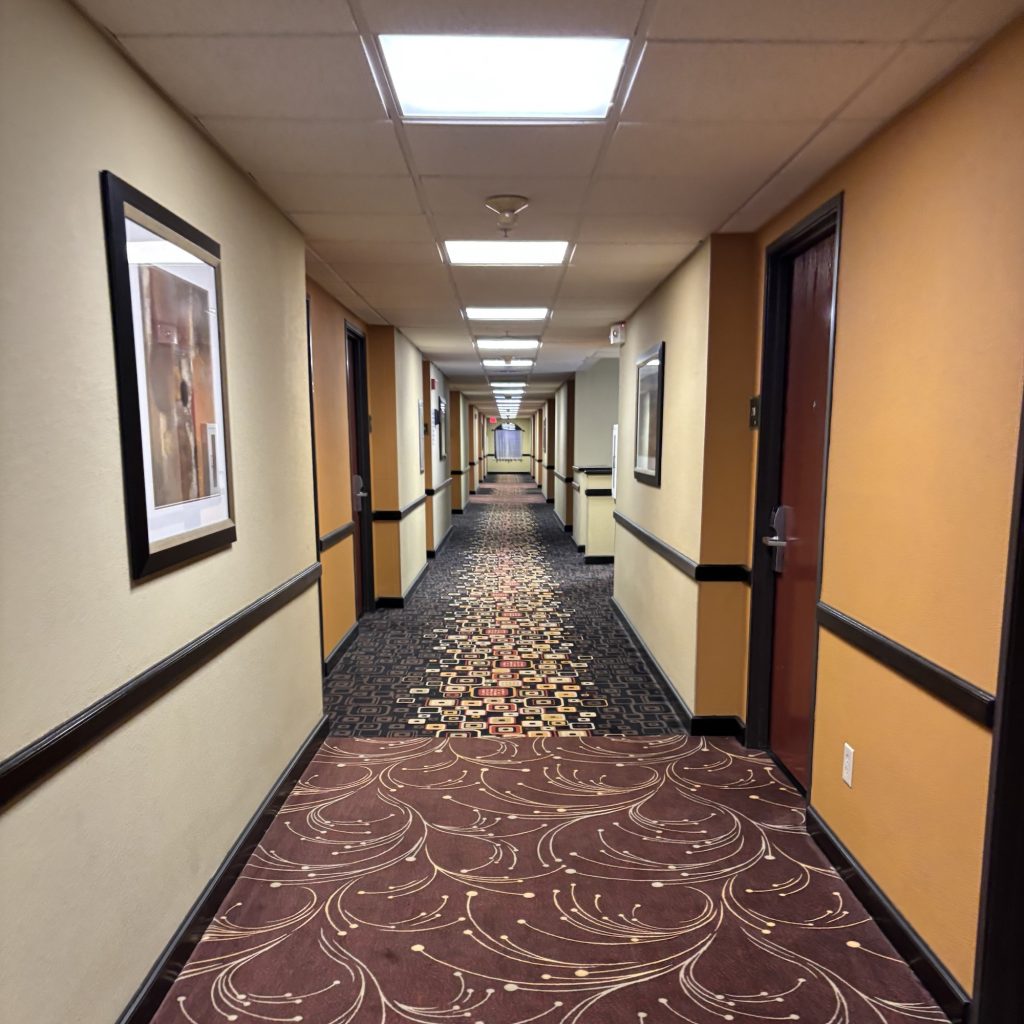
A hallway, neither the place you came from nor the place you’re going.
A car ride is liminal, a bubble that’s neither here nor there.
Life seems to be what happens in the in-betweens. We mark life as beginnings and endings, starts and stops. But all of the growths, trials and triumphs, happen in the messy space between.
Sometimes liminal settings feel creepy to some people, like being alone in an old elevator. It feels abandoned, out of place, and outside of time, even though the lights shine brightly.
My best friend caught on to how my thoughts were moving, and mentioned a counterpoint she’d been thinking about. She’d noticed speed in competition shows, where time feels frantic and fast compared to the slow pace of a liminal space.
In a way, her point reminded me of a talk from Terrence McKenna.
He said that time for the collective is speeding up. We can see the speed reflected in how many events happen in a span of time. The pace of time we live in is full of events constantly, honestly overwhelmingly. It’s so rapid compared to the past, when it could take millions of years for a single species to evolve. Even in more recent past years, events didn’t feel this fast.
Revisiting that led me down another branch, reminding me of something I’d read about biology.
The theory was that multiple species have a lifespan limited to a similar number of heartbeats. A mouse and elephant have similar ranges of heartbeats in their lives, even though their lifespans are very different lengths. Mouse hearts beat rapidly, elephant hearts beat slow and steady.
Given, human heartbeats have outpaced the range due to medicine. But it makes me think that maybe heartbeats are the anchor to how we perceive time. Maybe perception depends on whether we’re in the quick or slow heartbeats.
But that doesn’t really contradict with liminal time. It’s not exactly about the speed of time. It’s more about the transition.
We measure our existence from point A to point B, the beginning of an hour to the end, the start of movement to our destination. But time isn’t really the hour itself, it’s what happens within the hour. It’s the space between the clock’s ticks, the experiences between start and finish. Time could be fast or slow, depending on what fills the space between the measurements.
My friend nodded, “time really is just what happens in that time.” I watched the minute change on my phone’s clock.